Română
 Serbian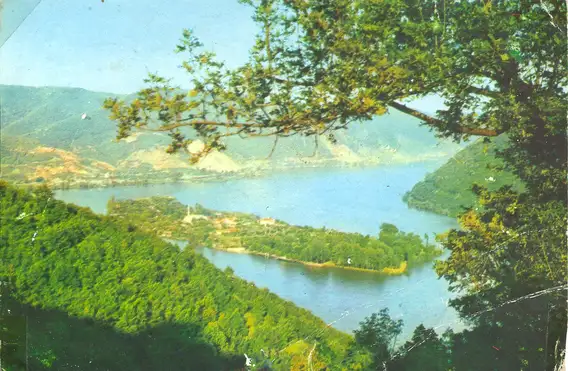
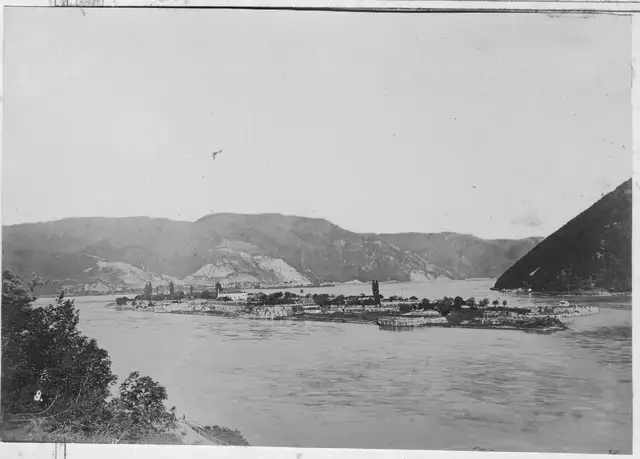
The isle placed downstream of Orsova, had 48 m in altitude being dominated by the Alion Hill which was 317 m high and placed north side of the Danube and south of Golubinska Planina. The isle’s length was of 1750 m and its breadth of 400-500 m.
In the medieval documents, the isle had other names too: Carolina, Porizza, Ciughene Adasia (The Gypsy’s Isle), Ada-I-Kebir (Ostrovul Mare). The name of Ada-Kaleh (The Citadel Isle) is generalized after 1788 and becomes official in 1878. The Ada-Kaleh Isle was owned alternatively by the Turkish and Austrians. The first fortifications were made by Iancu of Hunedoara, voivode of Transylvania, in order to stop the Turkish infinite. The isle had an uneasy history due to its strategic placement, being continuously either under the Turkish or the Austrian ownership. During 1718-1739, when the isle was owned by the Austrians, it was built the citadel of Vauban type in a star shape.
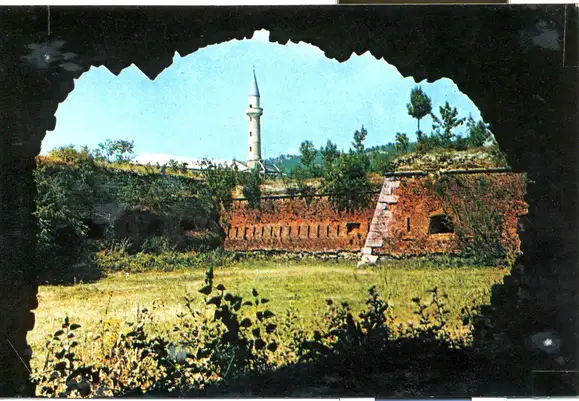
The citadel had a parallelogram shape and was endowed with bastions, casemates and defence ditches. The fortifications were linked by underground roads. Once with the construction of the Iron Gates I hydro-energetic and navigation system, the Ada-Kaleh Isle was flooded by the Danube’s waters but the citadel was displaced on the Simian Isle.
The Austrian-Turkish Wars at the end of the XVIIth century and the beginning of the XVIIIth, proved that in the Iron Gates region was necessary to be constructed some citadels following a new system in order to resist against the artillery.
In 1689, General Veterani, from of the austrian army wants to build a pentagonal citadel on this isle. His proposal was supported by Count Marsigli and so were built ditches and palisades. Between 1716 and 1718, Eugeniu de Savoia asks Banat’s future governor to continue the works for building the citadel. The preliminary spade works begin in august 1717 when the isle is bounded to the shore by a bridge formed by boats to carry the materials. In 1737 the isle’s fortification is finished. Besides the proper citadel, there were also two exterior belts of fortification. Being given the isle’s configuration, the citadel had an oblong star shape. It was endowed with common bastions and casemates which were linked by arched galleries made of brick and which formed a large inner court. The access into the citadel was possible through a series of eastern and western baroque gates. The 25 m high walls were also made of brick. Over the eastern gate it was built a mosque, rebuilt in 1903 on the place of the Franciscan Monastery’s Church. On one of the eastern gate’s walls, dating since 1739, there is an inscription that aggrandizes the Turks’ victory.
Being a citadel of Vauban type, Ada-Kaleh was built by Austrians after The Peace of Karlowitz (1718). Occupying a big part of the isle’s territory, the citadel reprezented one of the most important fortifications of this type from Europe. Soon after it was finished, the citadel was conquered by the Turkish. This fact was attested by The Pace of Şiştov which stipulated that Ada-Kaleh would remain under the ownership of the Turkish and the nearby Orşova would be given to the Austrians.
By The Peace of Berlin (1878), Ada-Kaleh remains a Mussulman oasis on the Danube, property of the Sultan but under Austrian-Hungarian administration with a special statute. The isle had one mayor, a judge and a priest – Turkish and the hoisted flag was also Turkish. Since 1923, the isle’s population requested the island’s joint to Romania.
In the middle of the XX-th century the local community was of Turkish origin. The settlement developed within the inner space bordered by the fortification. The houses were built of brick taken out from the citadel walls and a part of them raised quite above the casemates. The each interpenetration of the civil and military architecture, the isle and fortification’s invasion by the submediterranean vegetation were elements of picturesqueness which together with the value of the monuments contributed to the fame of the place.
Along with the construction of the hydropower and navigation system Iron Gates I, arose the problem of preserving the fortress and displace it on Şimian Isle. Therefore, between 1966 and 1968 on the Ada-Kaleh Isle were made archaeological researches and marked the main architectonical elements to help reconstruct the monument at its new location. So, on the Simian Isle it was reconstituted a part of the proper citadel, moved some funerary monuments from the old Ada-Kaleh’s cemetery among which the Mischin Baba’s tomb.
Witness of many historical events, the Simian Isle represented the ideal place to reconstitute the citadel of Vauban type from the Ada-Kaleh Isle. The Şimian Isle was inhabited since Neolithic, through the Bronze Age and Dacian-Getic and Roman civilizations.